
Table of Contents
Uncle Gary Is Not Going to Change Your Mind (And Neither Are You)
Why political posts on Facebook almost never work, and what they quietly cost us when we make them anyway.
Open Facebook for thirty seconds and you’ll see three things, in this order: someone’s beach photos, a “Happy birthday, wonderful human!!” message for a coworker you’ve met exactly twice, and a 400-word manifesto on tax policy from someone you went to prom with. They’ve got graphics. They’ve got a source they probably skimmed. They have feelings, and they need you to have them too—ideally before you’ve finished your coffee.
Like their post or else.
This is an article about that person. Actually, no. Let’s be honest before we go any further: this is an article about all of us, because nearly every politically engaged person has been that person at some point.
Full disclosure, in case you’re new here: I’m not writing from the sidelines. I follow the news closely, have opinions on most of it, and genuinely enjoy a good argument. Four years on my high school debate team, four more in college, and a degree in international relations will do that to a person.
So when I say that broadcasting political opinions across a mixed Facebook audience is usually a poor way to change minds, it isn’t coming from someone who has checked out. It’s coming from someone who spent years sharpening the exact skills Facebook claims to reward—and eventually noticed that the platform has very little use for them.
By lunchtime, you’ve quietly hit “Unfollow” on prom guy. Not “Unfriend.” You’re not a monster, and you might still want to see his kid’s soccer photos in December. Just “Unfollow” a small, quiet, extremely effective act of self-preservation.
You didn’t necessarily disagree with him. You just wanted your vacation photos back. Here’s the part that stings: somebody, somewhere, has probably done the exact same thing to you. We rarely catch ourselves in the act. We just notice everyone else’s noise.
I recently tried to remember the last time a political post on my feed genuinely changed my mind, not softened it slightly or made me think, “Huh, interesting point,” but actually changed it.
I came up empty.
Then, worse, I started mentally tallying friendships that had simply faded. No blowup. No dramatic falling-out. Just a slow retreat, one scroll at a time, because the daily drip of ideological hostility eventually wore down the desire to stay connected.
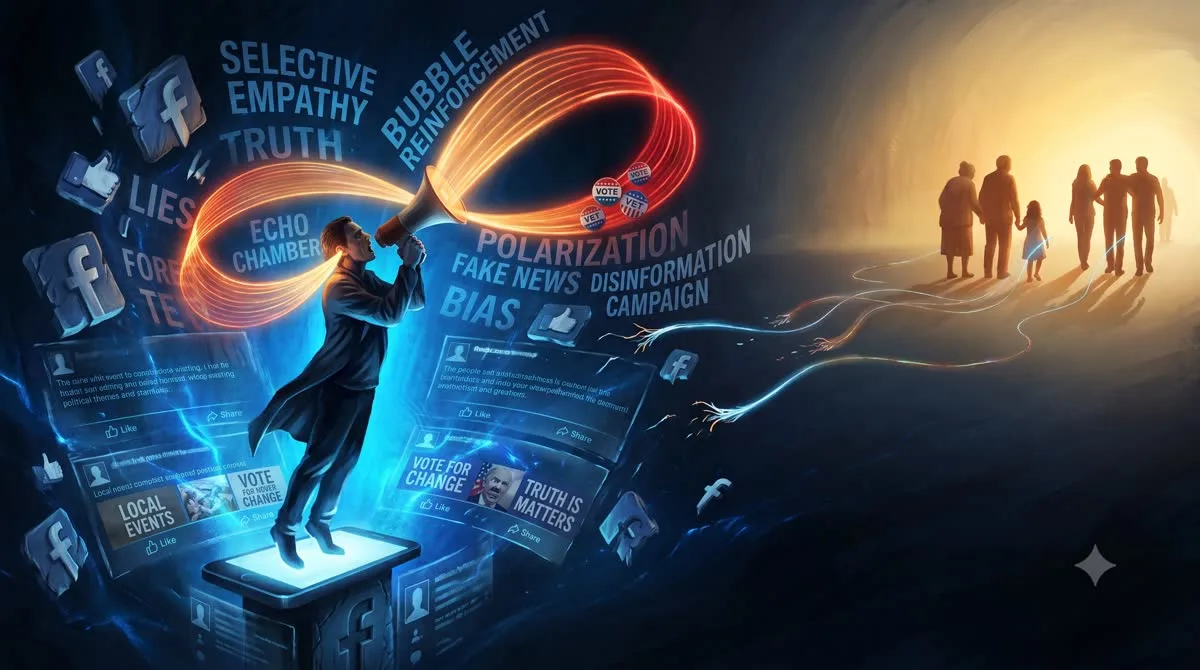
For more than fifteen years, we’ve been turning personal networks into a permanent state of ideological alert. And through all of it, one paradox has barely budged: the people most likely to applaud our posts already agree with us, while the people we imagine persuading are usually becoming more defensive, more irritated, or less interested in hearing from us at all.
So why do smart, decent, otherwise reasonable people keep doing it, day after day and post after post? Why do we overestimate our persuasive power while ignoring the social bill quietly coming due?
It turns out this isn’t only about politics. It’s about human nature.
The Uninvited Thanksgiving Speech

Picture Thanksgiving.
The turkey is being passed, someone is telling the story about the time Grandpa backed the boat into the lake again, and the room is warm and a little too loud in the good way.
Then Uncle Gary stands up. Nobody asked Uncle Gary to stand up. He clears his throat like he is about to toast the bride and groom and instead delivers a fifteen-minute address on immigration policy, complete with hand gestures and a rhetorical question directed at nobody in particular.
Watch what happens to the room. The air just leaves it. Nobody’s mind is changing over cranberry sauce. The relatives who agree with Gary nod along, looking vaguely embarrassed on his behalf. The ones who don’t stare very, very intently at their mashed potatoes, silently willing this to end.
Then the rescue operation begins. Someone brings up football. A child asks, with impeccable comedic timing, whether there is pie yet. Someone volunteers to check on the coffee in a kitchen that does not need checking on. Grandma steps in with the strained smile of a woman who has personally de-escalated forty Thanksgivings and is not about to lose this one.
Nobody enjoys the Gary speech. Not even Gary, if he’s honest, twenty minutes later.
Facebook has become the only dinner table where Uncle Gary’s speech is permanently scheduled and never actually ends.
We instinctively know not to behave this way in most areas of real life. We save heavier subjects for coffee with a friend who wants to discuss them, a town hall, a campaign meeting, or a group chat literally built for arguing. We generally leave them at the door for weddings, baby showers, company picnics, and retirement parties.
It would be deeply strange to stand up during your coworker’s farewell luncheon and deliver an unsolicited address on tax reform.
And yet social media flattens your entire life into one room. Your boss, your child’s soccer coach, your college roommate, your favorite client, your neighbor, your cousin, and your uncle who forwards things are all seated at the same table, whether they want to be there or not.
Researchers sometimes describe this as “context collapse”: audiences that would ordinarily remain separate are compressed into one undifferentiated crowd.
Every unprompted political manifesto is you standing up at that table, tapping the glass, and asking everyone to stop looking at the vacation photos and listen to you for a minute.
There is, of course, a difference between publishing an essay that people voluntarily choose to open and inserting a political speech into the personal feed of nearly everyone you have ever met.
Consent matters.
Context matters.
Facebook is particularly bad at preserving either one.
The Reality of Persuasion

To be clear, persuasion does happen. Social movements have changed laws. Investigative journalism has exposed corruption. Organizers have mobilized communities. Patient conversations between people who trust one another have changed minds.
Political posts can also serve legitimate purposes. They can publicize a voting deadline, recruit volunteers, raise money, share firsthand experiences, correct a dangerous rumor, or direct people toward a specific civic action.
But these successful forms of communication usually share a pattern: trust, relevance, evidence, a receptive audience, and a concrete purpose. Very little of that resembles a furious meme sandwiched between your cousin’s engagement photos and an advertisement for weighted blankets.
Pew Research Center has tracked how political disagreement affects people online, and the findings are not especially encouraging. Among social media users who discussed politics with people they disagreed with, the share who said those exchanges left them feeling they had less in common than expected grew from 64 percent in 2016 to 72 percent during the 2020 election cycle.
We are not necessarily converting anyone. We may simply be confirming everyone’s worst suspicions about one another more efficiently than ever before.
There is a psychological reason for this. When a political argument challenges something tied closely to a person’s identity, values, group membership, or sense of morality, the argument is rarely processed as a detached academic proposition. It can feel personal. Instead of calmly weighing the evidence, people begin defending the beliefs, and the identity being challenged.
We hunt for weaknesses in the source. We question the motives of the person who shared it. We recall evidence that supports what we already believe. We dig in.
This is often described as motivated reasoning or identity-protective cognition: our reasoning does not disappear, but it becomes enlisted in the defense of conclusions we already prefer.
Deep down, then, many political posts are not really aimed at persuading the opposition. They are performances for people who already agree.
The tone, the graphic, the pointed word choice, all of it reassures our side of the table that we remain loyal, alert, and appropriately outraged. The post has accomplished its emotional purpose the moment an ally leaves a supportive comment or a fire emoji, regardless of whether a skeptic reconsidered anything.
It was never entirely about them.
The Architecture of Outrage
Here is the part the platforms figured out long before the rest of us did:
Outrage is extremely good for business.
A prominent study published in the Proceedings of the National Academy of Sciences found that moral-emotional language significantly increases the spread of messages within political networks. The righteous, the furious, and the “I cannot believe I even have to say this” posts travel farther than calmer ones.
Anger is, in the most literal sense, good content.
Later research published in Science Advances demonstrated how social feedback can reinforce this behavior. When users receive likes, shares, and approving responses after expressing outrage, they become more likely to express outrage again.
The platform quietly rewards the loudest version of us, over and over, until loud starts to feel normal.
This is one reason political posting can become compulsive. It serves several psychological purposes at once.
It signals identity: This is who I am.
It signals belonging: These are my people.
It signals moral seriousness: I am paying attention and I care.
It reduces anxiety by converting helplessness into expression.
And it occasionally pays out a variable reward in the form of praise, attention, or a surprisingly successful post—the same unpredictable reinforcement pattern that makes many digital experiences difficult to put down.
We tell ourselves we are informing the public.
Sometimes we are.
But often we are regulating our own emotions in public and asking our audience to participate.
The Reader’s Dilemma
If the feed has become so exhausting, why don’t we simply close the laptop, delete the app, and leave?
Because social media is not only a political battleground.
It is also where we track birthdays, see pictures of newborn grandchildren, celebrate weddings, find out that an old classmate has died, organize reunions, locate missing pets, and remain loosely connected to people we might otherwise lose completely.
We tolerate the political exhaust because we do not want to surrender access to the human relationships.
We stay for the milestones and treat the ideological landmines as a tax we must pay to remain connected to the people we care about.
The Ledger Nobody Shows You
The next time you post something spicy, imagine it as a small business.
On the profit side of the ledger, you can see everything: the fourteen likes, the three approving comments, the supportive emoji, the little dopamine bump.
Real. Visible. Satisfying.
Now try to see the other side of the ledger.
You can’t. It is invisible by design. You cannot see your old college roommate quietly muting you because she comes to Facebook to relax, not to referee. You cannot see the coworker who files away a small, unflattering thought about your judgment. You cannot see the client who begins to wonder whether working with you will eventually involve more ideological friction than it is worth. You cannot see your cousin deciding, without mentioning it to anyone, that perhaps this year’s cookout invitation list should be slightly shorter.
Silence on your timeline is not necessarily the sound of universal agreement. Often, it is the sound of people quietly leaving the table to protect their peace. They do not issue a formal notice.
They simply stop showing up.
The Illusion of Productivity
Here is the deepest and most seductive trap: Posting feels like doing something.
We have a genuine and healthy instinct to stand up for what we believe is right. The internet allows us to satisfy that instinct with almost no friction. You post the article. You receive validating comments. Your conscience quietly checks a box:
Duty done. Injustice addressed. World nudged in the right direction.
Psychologists have described related patterns as self-signaling, symbolic action, and, in some circumstances, moral licensing. The labels vary, but the danger is simple: the feeling of having acted can sometimes substitute for more difficult action.
The post may not have fed anyone. It may not have visited an isolated neighbor, tutored a struggling student, registered a voter, attended a local meeting, donated to a legal fund, or filled an empty volunteer shift.
Somewhere, a local food bank may still be short of help, and it will not be saved by your sixty-one reactions, however satisfying they felt.
Real civic action is slower and less photogenic.
It is a Tuesday night city council meeting where nothing dramatic happens for two and a half hours. It is tutoring one child once a week for an entire semester. It is knocking on doors, making phone calls, delivering meals, reading legislation, serving on a board, or helping a neighbor complete a form. It costs time. It does not always produce applause. And it is far more likely to be noticed by someone downstream.
Posting can deliver much of the emotional payoff of activism without the inconvenience. That is not necessarily a character flaw. It is how the tool was built.
The Casualty of Curiosity
If you zoom out on this cycle, the greatest loss may not be persuasion. It may be curiosity. Political posting runs largely on certainty: certainty that we are right, certainty that the other side is malicious or confused, certainty that a public declaration is necessary. But genuine persuasion rarely begins with certainty. It begins with curiosity and a question asked as though you actually want to hear the answer.
People do not usually change their minds because someone loudly informed them in a comment section that they were stupid, immoral, or deceived. They become more open when they feel heard first.That tends to happen privately, gradually, and with someone who is not performing for an audience.
Replace conversation with broadcast, and you may trade away the one ingredient that had a chance of working.
For the Record
 Does any of this mean I do not have political opinions?
Please. If you have met me in person you know better.
I have plenty, and I will happily talk your ear off about them over coffee, in person, where tone of voice still exists and you have voluntarily entered the conversation.
What you generally will not find is a stream of them on my personal feed.
Scroll through my posts and you are more likely to find Buenos Aires, Istanbul, Puerto Vallarta, Paris, Madrid, Rome, and an entirely unnecessary amount of documentation from my cat Miss Kitty’s seventeenth birthday—an event I regret nothing about.
I did not arrive there accidentally.
I arrived there after doing the math: routine political broadcasting on Facebook has produced very little benefit I can identify and several forms of quiet damage I cannot measure.
That does not mean everyone must remain silent.
It means we should distinguish speaking from persuading, expression from action, and a willing audience from a captive one.
Before You Hit Post: A Breathalyzer for Your Opinions
This isn’t a call to go silent, delete the apps, and never have a view again. It’s just an invitation to add ten seconds of friction before you hit the button. Ask yourself:
- Am I informing, or am I venting? If there’s a hot flush of anger behind it, this one’s for you, not your audience.
- Who do I actually think is going to read this? Be honest, are you hoping to persuade someone, or are you just checking whether your side of the table already agrees with you?
- Could this bring me closer to someone in my actual life? Or is it more likely to plant a small, quiet wedge?
- Am I willing to pay the invisible cost if I’m wrong about who’s watching? Because someone’s cousin, coworker, or old roommate is always watching, and you don’t get an itemized receipt.
- Is there a better use of the next ten minutes? A text to an old friend. A call to a neighbor. Literally anything with a pulse on the other end.
None of this makes you spineless. It just means Uncle Gary sits back down for a second and thinks before the speech.
What Actually Gets Remembered
Five years from now, almost nobody in your network will be able to recite the specific opinion you broadcast on a Tuesday in July.
They will not remember the article, the argument, the meme, or the clever comeback you typed at 11 p.m. and found so satisfying.
They will remember how being around you felt.
They will remember whether your presence—online and off—was mostly friction or mostly warmth.
Twenty years from now, your grandchildren are not going to ask about your greatest comment-section takedown.
They may remember you teaching them to bait a hook badly on purpose so they would think they had done it themselves.
They may remember the fundraiser you quietly organized when a neighbor’s house burned down.
They may remember that you listened.
Social media is not going anywhere, and neither is Gary.
There is a little of him in all of us, standing at the table with something important to say.
The trick is not silencing him.
It is teaching him, gently, that the pumpkin pie can wait ten more seconds—and so can he.
References
- Pew Research Center (2020). “55% of U.S. social media users say they are ‘worn out’ by political posts and discussions.” Among users who talk politics on social media with people they disagree with, the share who say it reveals they have less in common than expected grew from 64% (2016) to 72% (2020). Read the report
- Brady, W. J., Wills, J. A., Jost, J. T., Tucker, J. A., & Van Bavel, J. J. (2017). “Emotion shapes the diffusion of moralized content in social networks.” Proceedings of the National Academy of Sciences (PNAS). Found that moral-emotional language significantly increases a message’s diffusion within (but not across) ideological networks. DOI: 10.1073/pnas.1618923114
- Brady, W. J., McLoughlin, K., Doan, T. N., & Crockett, M. J. (2021). “How social learning amplifies moral outrage expression in online social networks.” Science Advances. Found that social feedback (likes/shares) reinforces and escalates users’ expression of moral outrage over time. DOI: 10.1126/sciadv.abe5641
Discover more from Global Watchdog
Subscribe to get the latest posts sent to your email.
